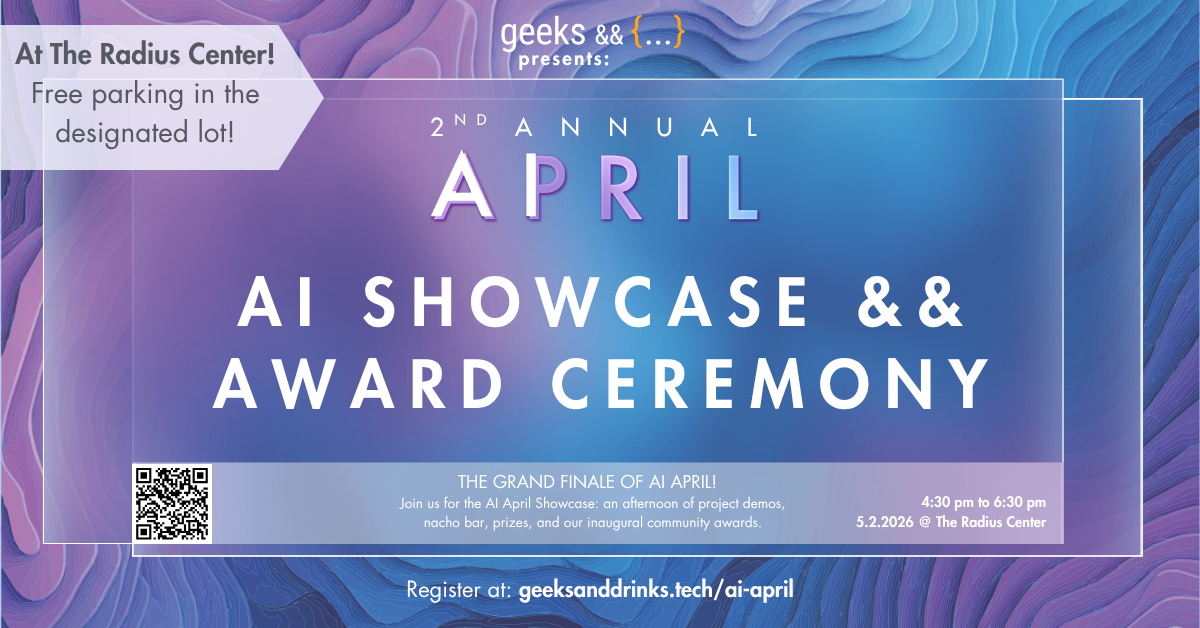
2026 AI-April Showcase && Award Ceremony
Meet the builders behind this year's AI-April Showcase. Browse their projects, see what they built, and explore the tools and technologies they used to bring their ideas to life.
Awards
Three awards were presented at the showcase on May 2nd. And the winners are...
Best in Show
Argis Labs, Inc.Awarded to the most impressive overall project at the showcase.
Best Solo Hack
Guard Rails Cyber-Security AgentAwarded to the best project built entirely by a single person.
People's Choice
FirmLink LegalVoted on by showcase attendees on the night of the event.
Projects
12 projects are showcasing this year. Check them out below!
Argis Labs, Inc.
by Zac
America has a sidewalks problem nobody talks about. 65% of curb ramps in this country don't meet ADA standards, 48% of sidewalks fail federal accessibility guidelines, and the cities responsible have no real way to find or prioritize the failures. Most ADA Transition Plans are years out of date — not because cities don't care, but because the only tools available are clipboards and survey crews at $200 per mile. Argis Labs deploys autonomous SCOUT robots that scan cities at walking pace, then runs a 3D computer vision / AI pipeline that detects every ADA violation from the raw LiDAR and generates legally defensible compliance reports, auto-synced into the city's GIS. What used to take a survey crew six weeks now takes four hours.
Built with
Python (FastAPI, scipy, laspy, sklearn), PostgreSQL, GCP (Cloud Run, Cloud SQL, Cloud Storage), ROS 2
Guard Rails Cyber-Security Agent
by Vincent Oliver
AI agents are shipping into production faster than the security tooling around them. Every team writes its own audit logging, kill switches are afterthoughts, and approval workflows get copy-pasted into each new system. Cybersecurity exists for humans — through firewalls, EDR, and SOCs. It did not exist yet for the agent layer. That gap is the project. Guard Rails MCP exposes four governance primitives over a Model Context Protocol server: an append-only audit trail, a kill switch, per-action policy lookup, and Slack-based human approval. On top of it, the AI Security Operations Center is itself an AI agent that uses the same MCP server every other agent in the fleet connects to — producing recursive accountability. The agent watching agents is itself governed. The AI-SOC runs four detectors: a Behavioral Analyst (using Claude Sonnet 4.6), a Prompt Injection Sentinel, a Secret Leakage Sniffer, and a Compliance Sentinel. High-severity findings autonomously pause the offending agent via kill switch; medium-severity findings route to a human in Slack.
Built with
TypeScript (strict mode), Next.js 16 (App Router), Tailwind CSS v4, Vercel Postgres (Neon-backed), Upstash Redis (Vercel KV), Claude Sonnet 4.6 via @ai-sdk/anthropic, Model Context Protocol SDK, Slack Bolt + Slack Web API, Drizzle ORM, Zod, ioredis, pnpm workspaces, Vitest (76 tests), GitHub Actions
FirmLink Legal
by Jose Martinez
Law firms lose cases due to slow intake and missed responses, so I built FirmLink Legal to automate conversion and generate branded client portals for secure document exchange. I spent Sundays doing deep research on the topic, created my own podcast-style learning materials using text to speech, listened during the day and developed at night for months. As the tools got better and I learned more, I iterated many times until finally reaching the point of being ready for pilot testers. My goal is to provide the easiest to use, most cutting-edge tech to personal injury attorneys and help them automate and scale their practices.
Built with
TypeScript, AWS, ChatGPT, ElevenLabs
AdLlama
by Mauricio Degregori
I started AdLlama after leaving a startup where I ran Google Ads as part of my role. They wanted an AI way to manage it after I left, so I started building — first with MCP for campaign creation, then ad copy. I realized campaign creation wasn't sticky enough for agencies. Pivoted to search term QA after a design partner showed me that's where the real pain was. Built the whole thing solo with Claude as my engineering partner. Now live and used in real client calls weekly, catching things human analysts miss. Ad copy is next!
Built with
Next.js, Vercel, Supabase, Claude API (Anthropic), Google Ads API, Railway, Stripe, Resend, Browserless
RentBamboo
by Matthew Kanakidis
We got scammed for an apartment in San Antonio, and that led to creating an apartment marketplace for college students — which then led to the inspiration to create RentBamboo, AI agents to help property managers scale.
Built with
OpenAI, MongoDB, Fly.io, AWS, Claude
Teaching Teachers AI — A K-12 Curriculum for the Classrooms That Need It Most
by Al Dungo
I grew up in Uvalde. No CS class. No coding club. No one telling me this world was for me. That's why I built this. Through a partnership with MakeWater and the WeTeachCS initiative (Texas Advanced Computing Center at UT Austin), I designed and plan to deliver a 28-hour, 4-day virtual professional development program for K-12 teachers in Region 20 — San Antonio and the surrounding districts that need it most: Title I schools, rural campuses, schools that have never offered a CS course. The program runs teachers through computational thinking, Python and Scratch fundamentals, hardware (each teacher leaves with a micro:bit water quality kit), and on Day 3 — AI. Not AI as a buzzword. AI as pattern recognition, data interpretation, and a tool they can demystify for a 7th grader. The teachers who go through this leave with TEKS-aligned lesson plans, a pathway toward Texas CS certification, and the confidence to say "let me show you something cool" to students who are exactly where I was.
Built with
Python, Scratch, micro:bit (MakeWater hardware kit), Zoom, TEKS-aligned curriculum framework, WeTeachCS (TACC/UT Austin), Google Workspace, AI literacy integration
KeepTabz
by Franklin Morris
I was a Director/VP of marketing for 15 years, and founded the company in order to solve a problem I felt for a long time. Everything had become much more competitive, and yet there was no structured way of tracking competitive activity across all of the channels I cared about as a startup marketer. So we built KeepTabz to help companies track everything their competitors are up to in a single app — news, reviews, social changes, pricing and messaging shifts, traffic spikes and paid advertising campaigns — then let them get alerts when something important happens.
Built with
Next.js 14+, TypeScript, PostgreSQL w/ Vercel, Gemini and Anthropic AI models, custom-built scrapers, external competitive data APIs
SHRQ: AI-Powered Radio Broadcast
by Luke Hill
Streaming my music makes me feel a lack of ownership over my music library. I recently found an old hard drive with all my MP3s from high school and decided to build a digital DJ to dive into my old library — helping me resurface the songs I grew up listening to!
Built with
Python, Ollama, OpenAI Voice Models
EEVET AI Booking Agent
by Ben Hodge
I used to book shows but I couldn't work for artists that made less than $700/event because I only make 10% of what they make. EEVET can. EEVET is an AI Talent Buyer and Booking Agent for independent artists.
Built with
MemPalace
Orbital Trust Fabric
by Jacqueline Suttin
Three curves are colliding: compute availability is exploding (pushing machine-to-machine traffic past human-originated traffic), data centers are leaving Earth, and quantum compute is close enough that classical cryptography should be considered readable within the decade. Today's stacks were built for a different world. We built the runtime primitive that still works when none of those assumptions hold. The key insight: "human in the loop" is the wrong abstraction for autonomous infrastructure. In a retraining pipeline, an orbital node, or a high-frequency M2M chain, a human touching the system is usually the anomaly — not the safeguard. MagenTrust's behavioral scoring gave us a primitive we could invert: inside a Human Exclusion Zone, human presence triggers INTERRUPT. Every signed artifact carries a versioned algorithm field and supports hybrid classical-plus-post-quantum signatures, so a data center — terrestrial or orbital — can migrate one service at a time without re-architecting.
Built with
TypeScript, Node.js, Python, FastAPI, Model Context Protocol (MCP), MagenTrust SDK / MagenMCP, Ed25519 with hybrid post-quantum (ML-DSA) support, Redis, Postgres, Docker Compose, Kubernetes, Next.js, Tailwind, in-house LLM (The AI Cowboys)
Taleformed
by Akilah Littlejohn
The system was built using a core-first architecture focused on identity, data normalization, and provenance tracking. Multimodal AI was integrated to extract and interpret data from documents, images, and human narrative — going beyond basic OCR into semantic understanding. Throughout development, I learned to design around AI unpredictability by implementing validation, normalization, and user confirmation layers. Handling duplicate and conflicting data required building a lightweight identity resolution approach that preserves source context while maintaining a usable data model. Additional challenges included managing AI token usage, handling rate limits, and designing the system to remain resilient to model variability and ongoing updates.
Built with
TypeScript, JavaScript, HTML5, CSS3, Angular, RxJS, NestJS (Node.js), TypeORM, Google Gemini (multimodal vision + NLP)
Anatomy of a Customer-Facing AI Agent
by Tom McCracken
Most generative AI projects fail somewhere between a polished demo and a system a real customer-facing team will trust — so we set out to build the framework that closes that gap, using apartment locating as the testbed. The hardest problems weren't the model: they were context management, mixing client/staff/system messages, multi-channel ingestion, and making the whole pipeline observable enough for humans to actually rely on it.
Built with
Python, FastAPI, Jinja2 + HTMX (admin UI), LangChain + LangGraph, Anthropic Claude API, OpenAI API, PostgreSQL with pgvector, SQLAlchemy + Alembic, Pydantic, Twilio (SMS), SendGrid (email), Railway (hosting), GitHub